Monday, April 22, 2013

More on Mary's manifestation and Stewy's streetart

Just over a month ago,  Mary manifested!  Overnight Wollstonecraft appeared outside Newington Green Unitarian Church, courtesy the street artist Stewy.

Mary on the Green, the group campaigning for a statue, and Andy Pakula, the minister of the church at the heart of the village that changed the world* (and expanded Wollstonecraft's life), both bask in the reflected glory of the rather lovely life-sized image.

In the weeks since International Women's Day, the stencil on the wall has attracted a lot of publicity, as well as pilgrims and visitors. Here's a round-up (including interviews with yours truly):


There’s something about Mary, Hackney Post, Rachel Bayne

On a Stoke Newington corner, astride the New Unity Church railings, a banner proclaims ‘The Birthplace of Feminism’. In this small, Unitarian congregation beats a radical heart. Here, amongst the pews more than 250 years ago, sat Mary Wollstonecraft.

Last weekend, a mysterious portrait of the radical feminist appeared on the wall of the Church. The stencil, designed by graffiti artist Stewy was put there on International Women’s Day to celebrate the palpable influence Wollstonecraft made on the Newington Green community and far, far beyond.

Stewy’s painting also acts as a ghost-like trace, spearheading the path for a more lasting tribute in Stoke Newington. Roberta Wedge, local activist and member of the ‘Mary on the Green’ campaign, represents that hope with plans to build a statue of the feminist on Newington Green.
“I always say to people, if you were raised by a woman who could read and vote and work, then you owe something to Mary Wollstonecraft,” says Wedge.


Mysterious Banksy-style graffiti welcomed by Newington Green statue campaigners, Islington Gazette

The mural, which is the work of street artist Stewy – whose identity is unknown – emerged as events were staged in Newington Green to raise money for the statue and to celebrate International Women’s Day, which was last Friday.

Andy Pakula, minister of the New Unity congregation based at the chapel, said: “I hope we can leave it here because we think it’s fabulous. There’s different issues about street art, but she’s our guiding spirit. You’ve seen in the US where images of Jesus appear on toasted cheese sandwiches, well for us this is about the best that could happen to have Mary show up. She’s inspired us to work for justice in the world and we absolutely support the campaign for a statue. We would like to see a Mary Wollstonecraft centre for feminist studies in Newington Green one day.”

Writer Bee Rowlatt, 41, who is backing the campaign and recently published a chapter about Wollstonecraft in a new book titled 50 Shades Of Feminism, said: “It’s just unbelievable that there’s no permanent memorial to this incredible woman. The mural is really inspiring. She’s right there life-size on a building where she used to go. We feel like she’s appeared among us and we hope this is a small step towards getting the memorial.”


‘Apparition’ of 18th-century women’s rights campaigner Mary Wollstonecraft appears on church, Islington Tribune, Amy Smith

A MYSTERIOUS apparition on the side of the New Unity church in Newington Green caught the eye of passers-by when it appeared overnight. But it is not the “Mary” that some might expect. Instead, it’s a graffiti stencil of Mary Wollstonecraft, the influential 18th-century author and staunch advocate of women’s rights who was inspired by sermons at the church.

As a young school­mistress Wollstonecraft used to attend the New Unity church and its radical sermons were integral in shaping her political stance. Street artist Stewy was inspired by her message to create the piece. “I’ve been aware of Mary Wollstonecraft’s connection with the Unitarian Church for many years,” he said. “The placing of the image, where she may have walked, was important to me and I decided to make a small edition of 25 screen prints taken from the stencil to help raise money for ‘Mary on the Green’.” 


Mary Wollstonecraft "appears" in street art on her 18th C spiritual home! N16 magazine

New Unity Minister Andy Pakula said ‘This is a mysterious apparition of the mother of feminism - a daring figure who continues to inspire us in the fight for freedom and justice for all people. Without her spirit, it is unlikely that we would have stood forward so boldly for equal marriage, as we have in recent years. Mary's spirit has been with us always. Now her image is as well!’


Newington Green graffiti celebrates Wollstonecraft, Islington Now, Sarah Graham

Fans of famous feminist Mary Wollstonecraft are celebrating her surprise appearance in the form of graffiti on the side of a church in Newington Green. The stencilled image of the 18th century “mother of feminism”, by street artist Stewy, is a bonus for a local campaign to get a statue of Ms Wollstonecraft erected in the borough.

Islington-based movement Mary on the Green tweeted a photo of Stewy’s artwork, saying: “What a boost to the campaign! Mary manifests on NG church @newunity.” Newington Green Action Group set up the initiative in 2011 to make her life and work more accessible to local people.

Campaigner Bee Rowlatt said: “[Ms Wollstonecraft] is an internationally renowned champion of women’s rights and there’s no statue to her anywhere." Ms Wollstonecraft, author of A Vindication of the Rights of Woman, lived locally and attended the “radically-inclusive” New Unity church during her lifetime.


and even in the the newsletter of the National Museum Directors' Council

Street art evens up London’s representation of famous women: The image is clearly based on the John Opie picture of Wollstonecraft, which is on display in the National Portrait Gallery.  Mildmay’s Labour councillor Kate Groucutt says “I absolutely want it to stay. We’ve had confirmation from Hackney Council and they can’t remove it without checking with the owner, and that’s the church.  It’s not going to be painted over, we have secured that.” There are only a handful of statues to women among the hundreds in London. 


And the image is to be found as far afield as the United States UU World magazine: 
British Unitarians rally to save faith from extinction  by Donald E. Skinner

Unitarians in London gathered next to an image of 18th century Unitarian writer Mary Wollstonecraft. The image was created recently on the side of the Unitarian Chapel in Newington Green in north London, where efforts are underway to raise money for a statue of Wollstonecraft.

*************************
*The Village that Changed the World is the title of the beautifully illustrated little history produced by the Newington Green Action Group. It's available directly from the charity and no doubt from the online mega-retailer of your choice.
The photo above is, for a change, by me, of a pair of warm churchgoers on a cold day.

Wednesday, April 10, 2013

A Brave Woman There Was...

Next week sees another intimate gathering, drawing on the life and works of Mary Wollstonecraft. Truly, London is overflowing with remembrances. Again, three performers; again, words and music; again, a Camden library. But all else is different.

This is billed as "an encounter with Mary Wollstonecraft":
The show has three phases. First you will hear extracts from the Original Stories for Children and meet one of the great, though lesser known, characters of English literature, Mrs Mason. 
Hooray for this long-lived Lost Daughter, who started life as Margaret King, Mary's doubly rebellious charge during that dire year of governessing.
The scene then moves to Paris, during Mary’s stay in France, and introduces you to another outstanding, though perhaps less widely known, feminist writer, Olympe de Gouges.  
Ah yes, Mary in France. Tumultuous years. Did these two ever meet? There is every reason to hope so - certainly they moved in overlapping circles - but, as far as I know, no hard evidence. If this encounter did take place, it must have been in the first half of 1793; Wollstonecraft left Paris in June for a few months, and de Gouges was arrested in August, I believe. 
Finally we see Mary at her birthday tea, formulating ideas for her “Vindication of the Rights of Woman”, despite some hindrance from a male visitor. 
And who might that be, I wonder? Talleyrand or Godwin? Either way, I expect they get served wine in a chipped teacup.
Nearly all the script consists of the words actually written by the two women, but presented in dramatic form. 
That is much the same approach as last month's The Two Marys: A Conversation Piece, also at a Camden library. The borough has a claim on her (via The Polygon, within Somers Town, and St Pancras). 
Most of the music dates from the period.
Just like the birthday concert!

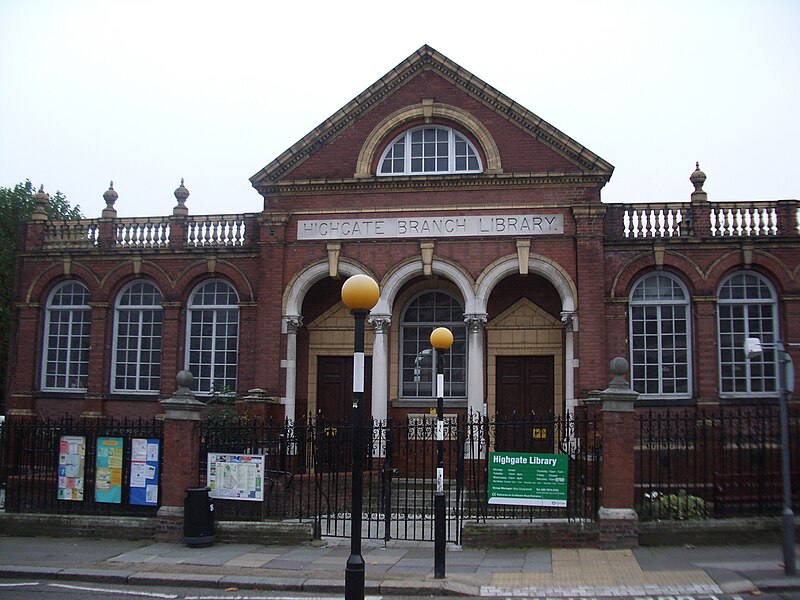
I'm not sure whether Mary Wollstonecraft spent much time in Highate, then a village as distant from London as Newington Green, and more difficult to get to, in that the muddy hills were worse. Still, in the years since then the good burghers of Highgate have taken advantage of Mr Macadam's tar, and the roads are quite passable these days.

If you are free next Thursday, why not visit Highgate Library? 18 April, 7:15 for 7:30pm.


************************************************
Photo by Justinc. Used under the 
Creative Commons Attribution-Share Alike 2.0 Generic licence.


Monday, April 8, 2013

Simon Schama admires

It's not often that Mary Wollstonecraft appears on television. My British readers have until Saturday to catch her on iPlayer here; the DVDs can be ordered worldwide and indefinitely, I believe.

Simon Schama, the historian and art historian, is probably best known for his BBC2 television project A History of Britain, produced about ten years ago. By series 3 he had worked his way to the late eighteenth century. Its first episode is "Forces of Nature", a curious title, as it deals with very human passions. Why did the British "prove immune to the siren call of liberty, equality and fraternity", as the blurb puts it?

First, twenty minutes of context and back story: 
Richard Price, Tom Paine, Edmund Burke. The Glorious Revolution of 1688 was referred to in 1789 with the fall of the Bastille. Liberty and reform were in the air. But the conservatives were afraid of revolution in Britain, and counter-attacked. You can tune in at 23:15, when the camera settles on the dining table of publisher Joseph Johnson, "one place where dangerous thoughts were positively welcome", as were "articulate, intelligent, impassioned women":
Among those women, the most striking was Mary Wollstonecraft. She was the spirit of the time and a one-woman revolution. Living a hand to mouth existence as a writer, Mary burst into print in outrage at Burke's Reflection. She also noticed that the rights of man weren't worth much if they excluded the other half of human society...

There was nothing she saw in her nature that disqualified her from being a full citizen.
The problem with filming history is that they're all dead. So mostly we get paintings, and close-ups of the title pages of books, and Simon Schama lecturing to us as we sit on the sofa. But there are also scenes featuring silent (and, as far as I can tell, uncredited) actors, in groups, pretending to listen to each other, or alone, sucking their quills in thoughtful anticipation of another burst of literary genius. When the action cuts to Paris, the picture editors go crazy for moody black and white shots of the bridges over the Seine:
To begin with, Mary shared the company and the optimism of expatriate Irish, English, Americans, and Scots at White's Hotel. But then, as the despotism of the Crown was replaced by the despotism of a police state, doubts began to creep in.
Schama stands in the Jardin de Luxembourg and recounts how, when Tom Paine was imprisoned there, he narrowly escaped his meeting with the "national razor". The Mary-actor, still with too much hair, sits by a solitary candle, looking scared, writing a letter to Johnson. The 1793 war between Britain and France made everything so much worse.

Mary must have felt it would be her turn any day. Salvation appeared in the good-looking shape of an American businessman and property speculator, Gilbert Imlay, who registered her as his American wife, and thus free from the taint of being one of the enemies of France. Nursing their baby in a quiet garden on the outskirts of Paris, Mary the feminist had been saved from the revolution by motherhood. 
But it was not to be a happy ending. As Mary became more devoted, Imlay's business trips became mysteriously prolonged. When she followed him as far as London, she found a new mistress.
And thus to the Putney Bridge plunge.

But she was not to be allowed her poetic suicide; a boatman pulled her out. She was 37 and she seemed to have lost everything except her child: her faith in revolution, in the virtue of the people, her belief in the possibilities of an independent woman's life, the goodness of nature, must have seemed a cruel joke.
But then, Schama says, she got a second chance: she met Godwin, and "Mary's fire burned bright enough to melt his icy principles." This is where the camera shots get a bit icky: they sit in armchairs on either side of a fireplace. He is reading, not aloud but silently; she sits with her hands clasped over her belly (Look! I am carrying his child!), no book within reach, gazing at her husband in doubly mute adoration.
Though they'd agreed not to cohabit, the sworn enemy of matrimony and the feminist were wedded at St Pancras Church. As her months of pregnancy passed, the two found themselves relaxing into conjugal cosiness to the point where Godwin was prepared, at least privately, to admit the force of emotion as well as thought. Which is what made the end so unbearable.
And then it all gets rather graphic - in Schama's choice of words, not in the images (no puppies, thank goodness). I can't decide if this brutality of expression is the sort of honest dealing that Godwin intended with his Memoirs, or if it is just gruesome titillation:

When the time for her labour came, Mary called a local  midwife. But after the baby was born, another girl, the placenta remained firmly lodged somewhere at the top of the birth canal.  
Obstetric opinion at the time held that unless the placenta was promptly expelled, there was a lethal danger of infection. So a doctor from Westminster Hospital was summoned and he stuck his hand up Mary and pulled. The placenta came away in pieces as Mary lay in agony, hemorrhaging.
She had been through so many terrors, so many ordeals, had come so close to death, and had somehow managed to survive. This time, with so much to live for, there would be no escape. She died a week later of septicemia.
Schama does a good job describing Godwin's immediate reaction, his heart-torn letters that day. And then he concludes these twelve minutes of Mary Wollstonecraft:
She is rightly remembered as the founder of modern feminism, for making a statement remarkable for its bravery and clarity, that the whole nature of women was not to be confused with their biology. But nature, biology, had killed her.
Sic transit. The episode rolls on to other defenders of freedom. The whole series is worth watching; it's as good an overview as you're likely to find, and equally relevant to our American cousins, up until our paths diverge.


Wednesday, March 20, 2013

London immortals

There is no statue to Mary Wollstonecraft anywhere in the world. There is, however, a sprinkling of public memorials to prominent women in central London. The local chapter of United Nations Women organised a walking tour of half a dozen of them last Saturday. Despite the persistent rain, a goodly crowd assembled, including a pair of self-possessed twelve year olds. Each statue had its designated champion, telling us about their chosen person, from national heroine to forgotten obscurity. Here is the group, listening to the story of Edith Cavell, at the impressive memorial outside the National Portrait Gallery. I even found the opportunity to expound for the benefit of Mary on the Green.

The walk started in Bloomsbury at Tavistock Square, wandered via Lincoln's Inn Fields to the Strand, along to Trafalgar Square, then Pall Mall and Whitehall and finally Parliament, a satisfying circuit through literary, legal, and legislative London.

The full list was:
Louisa Aldrich-Blake (1865-1925), the first female surgeon in Britain.
Virginia Woolf (1882-1941), a writer at the forefront of British Modernism.
Margaret MacDonald (1870 – 1911), a feminist and social reformer. 
Edith Cavell (1865-1915), a pioneering nurse more famous for her death. 
Florence Nightingale (1820-1910), not only a pioneer of nursing but also of statistics.
Women in World War II, the only sculpture not of a specific person. 
Emmeline Pankhurst (1858-1928), the leader of the suffragette movement. 

There are others: Time Out lists Violet Szabo and Sarah Siddons. The labour of love that is London Remembers provides endless browsing fascination; here's their page on the military monument. And the Victorian Web is very good between 1837 and 1901, as e.g. with Florence Nightingale

I've spent ages and ages making a Google Map, Statues of prominent women, with links and everything. Do have a look


Sunday, March 17, 2013

A musical birthday


Mary Wollstonecraft's 254th birthday will be celebrated by Chorus of Dissent and the Elastic Band, "featuring music performed in London during her lifetime".

The venue is Stoke Newington, in her day a village known for its Quakers, just as Newington Green, where she had her school a mile away across the fields, was associated with the Rational Dissenters, now Unitarians. The difference is that Stokey was the centre of the Church of England parish: it had St Mary's. In the eighteenth century this was still the little medieval building, but the sprawl of the metropolis a century later necessitated the construction of a Victorian barn (unusually, directly opposite its predecessor). Now St Mary's Old Church is on the way to becoming an arts venue, and St Mary's New Church appears to be thriving.

The tickets have not yet been released, but pencil in 5:30 pm on Saturday 27 April 2013 for a "delightfully short concert from Stoke Newington’s very own choir and professional orchestra". We are promised "scenes from Handel’s Messiah ... juxtaposed with Haydn’s Creation, the whole presented in our inimitable and inclusive Dissenting style". And who are these singers?
Dissenters was set up by Ruth Whitehead to offer local, inclusive and excellent creative arts experiences, without one iota of dumbing down. Drawing on her background as a professional musician she set up Chorus of Dissent and the professional orchestra, the Elastic Band. All Dissenters’ events are sponsored by her company Ruth Whitehead Associates, your local investment advisers and IFAs.
Lots more about Chorus of Dissent on their website. Here's how they began:
The 21st Century Dissenters gathered under an urban apple tree in the garden of a Thomas Cubitt house in Albion Road, Stoke Newington London N16, to discuss following in the footsteps of the local nonconformist heritage. Shamelessly leaning on our distinguished history of freethinkers, philanthropists and artists, from famous feminist writer Mary Wollstonecraft to Champagne Charlie (musical hall artist George Leybourne), Dissenters London N16 came into being.

***************************
Photo of the two St Mary spires 
by Tarquin Binary via Wikimedia Commons, 
used under Creative Commons share-alike licence.

Friday, March 15, 2013

Hidden re-appears


With the kind permission of the artist himself, Red Saunders.

Red Saunders created Mary Wollstonecraft and the Dissenters of Newington Green 1781 as part of his Hidden from History series. Thanks to the Socialist Worker, I am pleased to report that it is visible once more, this time in the People's History Museum, until the end of September. I wrote about the creation of this elaborate photomontage here.

[This is my 200th post, over two and half years. Not bad going.]


Thursday, March 14, 2013

The little girl who said "That's not fair!"

This morning I had the pleasure and privilege of presenting Mary Wollstonecraft to a whole primary school. The children were a delight to meet, and asked such sharp questions. I bet Islington's most influential educator would have loved to know them. She was the first to call for boys and girls to be educated together, the rich and the poor to spend years in each others' company: a national education in the truest sense.

First, I told the story of Mary Wollstonecraft, mostly of her childhood, anecdotes of standing up to bullies. Afterwards, I spoke to two of the oldest classes, one after the other, very different in flavour. I answered their questions and went where the discussion took us:
When was feminism invented? [N.B. I never used that word.]
Why couldn't girls go to school? [Because it had always been that way, and things needed to change.]
What did Mary die of? [The doctor not washing his hands. Cue a whole piece on maternal and infant mortality in Britain and in poor countries.]
What happened to the baby? [She was named Mary too, and grew up to write Frankenstein. Any bored kids at the back sat up straight.]
One class tenaciously tried to find some living relative:
What happened to her first baby? [I skated over that, lacking the skill to introduce suicide safely to pre-teens.]
The other Mary, did she have any children? [Yes, and all died except one.]
Did they have any children? [One by adoption, but none by birth.]
What about the big brother, the bully? [Ned became a lawyer. His son and daughter left England, ashamed of MW's reputation, and moved to Sydney.]
Some of the most acute questions came from girls wearing the hijab; some other hijabis were silent. The children who spoke were all completely fluent little Londoners, but of course I don't know about the ones who didn't speak, how long they've been here, how much they understand. One of the boys, who hadn't been paying much attention, said, "So was she just about rights for women then?" and my heart sunk a little, because I'd been saying just the opposite for the previous hour. "No, she wanted rights for everyone, for everyone treat each other decently."

Aside from that, though, it was all thought-provoking and enthusiastic. Another boy asked, "She said going to school was important. Why is it important?" I said, "That is such a wonderful question that I'm not going to answer it; I'm going to let the whole class tell us what they think." And we heard quite a range of answers: to learn to read and write, for respect, to get a job, to get a good job, to get inspired.

I forgot to ask the headteacher's permission to name the school, so I won't, but let's just say an inner London primary, responsible for hundreds of junior balls of energy, ranging from about five to eleven years old. The beautiful building has a pair of large interconnecting assembly spaces which double as the dining room and gym, so first I spoke with the youngest half of the school and then was whisked through a door into the other room to repeat myself for the older lot. Key stages one and two, as they are known in England.

My host teacher offered me music as an intro, to cover the classes walking in, and happened to have a CD of Tracy Chapman. I leapt at the chance to play "Fast Car": it wouldn't mean anything to the kids, but the teachers might get it. "You see my old man's got a problem/ He live with the bottle that's the way it is/ He says his body's too old for working/ I say his body's too young to look like his."

And this is how I began the story:
I'm going to tell you a story about a little girl who said THAT'S NOT FAIR. Have any of you ever said THAT'S NOT FAIR? Maybe you said it to your mother or father, or sister or brother, or teacher or classmate. Maybe yesterday or even this morning! Can you say THAT'S NOT FAIR? Let's practise.
Always a good idea to have a bit of interactivity, a phrase for the audience to shout on cue. Now for the setting. I don't know to what extent these modern children can imagine such a long-ago world:
This little girl's name was Mary, but before I tell you about her, I have to tell you about where she lived. It was very far away from us, not in place but in time. She lived in London, but London a long long time ago, when almost everything was different...
So, in this once-upon-a-time London, there was a family with a mum and a dad and a big brother and a little girl called Mary, and lots of little brothers and sisters. Sometimes Mary's family was quite happy together, but a lot of the time they were not very happy at all.  
One reason was because the parents worried about money, and the father went to the pub and drank with his friends. He drank a LOT. And he came home drunk and in a BAD mood, and he would shout at Mary and her brothers and sisters, and he would shout at Mary's mother, and sometimes he would hit the children and hit his wife too. What do you think about that? THAT'S NOT FAIR!
Alcoholism and domestic violence, as child-appropriately as possible. I was acutely aware that some children in the room may never have witnessed an adult slap a child, that the very notion might be shocking to them, while others may experience drunken mayhem in their own homes on a regular basis, and that no adult might actually have told them that what they are living through is wrong, it's not their fault, and it's not normal. I want the lucky ones to have some inkling of how lucky they are, and the unlucky ones to know they aren't alone. I wonder what the kids told their parents when they got home from school.

My main anecdote was about the ship in the storm, and how Mary stood up to the captain, and insisted he rescue the sailors in danger, no matter what flag they sailed under, because we are all human beings and must help each other. (Why am I surprised that telling these tales swiftly becomes so didactic?) And I concluded:
Eventually Mary came back to London and decided to be a writer. She wrote a book for teachers and parents, and a book of stories for children, and she wrote for magazines, and she translated from other languages into English (maybe some of you can speak other languages), and then she wrote two famous books. She looked around the world and she saw so many things that were wrong. She said THAT'S NOT FAIR!  
In the first book she said that everyone should have rights, that fairness is important, that we should all share power and responsibility. In the second book she said that women and men are equally clever and equally important, and that girls and boys both deserve to learn to read and write. Going to school is so important that all children should be allowed to, and their dads and mums can't stop them. 
So if we look around now, we can still see things that are wrong. Sometimes we still see one person hurting another, or taking more than their share. And we can say THAT'S NOT FAIR! and try to change things for the better, like Mary did.
Mary with the IGNITE crowd: sex and suicide and searching for silver. With the London Socialist Historians: radical international politics. With the WI (more hipster than hip replacement): women's rights. With primary school children: standing up to bullies, valuing education. Next on my wishlist: telling the Frontline Club about England's first war correspondent and first salaried journalist. (First female? First ever? I'd better do my research.)

**********************************************
Painting: "Sister and brother" by Pál Balkay (1785–1846) 
[Public domain], via Wikimedia Commons